milton station whenHere’s my Daily Art piece. I began with the found photo and you can find out more about why I chose it at my Mythos blog.

I scanned the original photo and adjusted the contrast a bit. Evidently the day it was taken the weather was overcast. Old black and white photos tend to be very low contrast. I wasn’t sure it would even scan well, but it did. My first step was to laser print the photo.

The linear quality of the telephone poles attracted me, as well as the handwritten notations. I have used stenciled telephone poles before in a piece called Camera Shy. I painted the Rives BFK® printmaking paper with Golden® Acrylic Micaceous Iron Oxide. This paint is worth getting if you are a fan of grey. It includes specular hematite ore and has a warm grey color, slightly shimmery. It doesn’t look like any other paint and it’s a big favorite of mine. It is expensive, as all good things are. I watered down the acrylic and it was still too opaque, so I kept washing it. The paper got really wet. This is not watercolor paper and I pushed it close to it’s limit…but it is good paper, just took a while to dry. This was ok since I got into a confunction with my printers and I had to alter that photo, but the clock was ticking on this one.

By the time I got the print out, the acrylic was dry and I took the telephone pole stencil and applied black acrylic paint. That has a short drying time. I adhered the photo copy down. The piece wasn’t finished and I wasn’t sure what it needed. Then I remembered the quote by Edmund White that I read this morning over coffee. “When a person dies, a library is burned.” I liked it so much I jotted it into my journal so that I would have it. I thought, this old photo has endured past the photographer’s own burned library…his story carried beyond his life. With the extra telephone poles, I had indicated further communication. That led to me handwriting the words “communicate-tell your story.” The photographer told his story, I found his photo and told my story through this art and in the writing of my other blog post. I hope you will go there. If you like art journaling, journaling, photography or using found photos, I think you will enjoy that post. I hope, at least, that you enjoy this art.

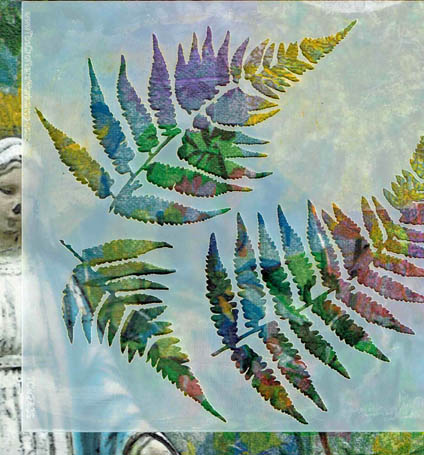
stencil overlayHi there. Lest you think I have turned into a Big Cheater, I haven’t. My Daily Art is drying. In the meantime I decided to show you this.

I was minding my own business after having applied light modeling paste to a piece of Rives BFK® printmaking paper. The experiment today was to use the modeling paste on a paper that could handle watercolor paint. Now, I’ve used spackling paste in the past to swipe over stencils to create texture. I have the light modeling paste which is better. It’s smoother and lighter and easier to spread, but it is also much more expensive. And I mean that from the bottom of my wallet.

I picked this fern stencil because I seriously love ferns. Ferns, to me, are the primary representation of endurance and survival of the fit. The fern family are some of the oldest life on this planet. It’s just science. Plus, there is the marvelous unfurling of the frond. Much is made of the rosebud opening to blossom, but what about those tightfisted fern buds?

When I applied the paste, I noticed some ink began to color the paste as I swiped. This was The Accidental Stencilists first Fortunate Event. It was fortunate because the color was very fern-y. Obviously, my lack of housekeeping the last time I used the stencil was paying off today. By the way, had I wanted to color the paste before coloring the background, I could have left the stencil in place, waited for the paste to dry, then spread acrylic over it or sprayed it with ink.

The modeling paste dries fast (so does spackling paste). Now for the next step. I wanted to use watercolors today. I have a bunch of tiny tubes of Cotman Water Colours® that I bought at a thrift for next to nothing. The good thing is that watercolor paint, even if it dries in the tube, is usable. You’ll have to destroy the tube to get at the paint, but it is doable. I’ve done it. Anyway, I put out Indian Red, Rose Madder, Sap Green and Cerulean Blue and went to it. I used a tiny brush to get into the fine fern branches and a medium sized brush to wash over the background. I am not happy with the background application of this piece. It is not as muted as I wanted. I tried to lift some paint but I didn’t have time. As the clock ran down, my final action was to throw some salt and dry rice on the page, which, hopefully, will diffuse the hard lines between colors.

I am not a proficient watercolor user. My love for it does not indicate any skill. For me, watercolor is a hard way to get good results; it  demands learning techniques and practice. Strangely, I am better with inks which are just as difficult but more predictable with spreading and blending. The ink is the same amount of wet, whereas, watercolor is different amounts of wet on any given brushstroke. There is likely a better descriptive word for this, but I don’t know it.

The Accidental Stencilist struck again by having a messy work island. A collaged canvas board has been loitering on my desktop for too long a time. I don’t know where to put it. As I was moving through the Daily piece, I cleaned the stencil and laid it on top of this other art. I glanced up and for a minute I didn’t know what I was looking at. In fact, I thought it might have been the wrapper for the stencil (as if it would still be in it’s original wrapper, silly girl!). It took a second for me to realize that I was seeing the other art beneath the stencil. It was real purdy. While I’ve talked about putting stencils over found papers, it never occurred to me to put it over my own art.This particular stencil would involve some severe fussy cutting, but other stencils wouldn’t. Just experiment laying stencils over your previous art, then lay them on the copy machine and voila! a custom collage element.

I thought the two accidents would be of more use to you than showing the Daily art today. I’ll forget the Accidents if I don’t share them now. I’ll show today’s art tomorrow–a twofer!

da1-5-16The Daily Art Challenge police would have no trouble spotting the crime here–1/4/16?? It’s 1-5-16–busted! Yes, after signing this today (in permanent Sharpie™ of course) I realized the correct date.

But, moving on to this odd fellow. The lettering is a stencil alphabet that I traced onto transparency in 8.5×11 size. Then I cut a light colored scrapbook paper to 8.5×11 size and copied the alphabet by running the paper through the printer tray. That way, instead of having to buy stickers or stamps, I can print any of my alphabet stencils into any paper. So, if you are following along with my Make Do Initiative, and I know you are, this is a creative way to make your supplies and tools more versatile and also you have stuff that nobody else has with no further financial investment. How cool is that?

For sure you remember the Dollar Tree stencil sets I’ve been bragging about. The big leaf gnome body is a stencil from the Sea Life set, cut out from an old map. The legs, arms and hat are cut from a botanical print. The tree and acorn were sketched in with a Stabilo-All®  Water Soluble Pencil (brown) and wet very delicately and smeared, which is where this pencil excels. I outlined the gnome and letters with Prismacolor® pencils. The face is from a stencil of four different cherubs.

I thought I was using Rives BFK Arches printmaking paper. During making, the paper was behaving UnBFK-ly; it was buckling. I held the paper to the light and discovered it had an Allstate watermark–it is half-sized paper I found at an estate sale and bought for it’s cotton rag content. This paper is not suitable as a collage foundation. Not sure how, but this piece was in with my pre-cut BFK supply. A tip and reminder: any foundation you use for collage has to be heavier than the paper you are applying.

I may have taken longer than an hour. It’s been a weird unpredictable day. Several business matters needed to be done during normal studio time. An installer is coming to put in some equipment. There’s been unusual unavoidable interruptions. My work was intermittent and I forgot the timer. The dog ate my homework.


da1-4-16Time passes, and to prove it, I now have a new folder entitled Terry Work 2016. Today’s Daily Art offering is a stamped feather image made by an eraser I carved. The foundation is cardboard. Somewhere on the Internet I described soaking cardboard for a few minutes and separating the layers. Well there you are, I just did it again. It’s really that simple. Poof–free paper. Ever since I saw the work of Hanne Matthiesen I wanted to use cardboard but I was sure it wasn’t as easy as she described. It is, just do it once and you’ll be hooked.

My Daily Art Initiative involves making a 5×7 paper foundation piece in one hour. I did this one in about 45 minutes and most of the time was spent trying to find some weird text to use. I had already carved the stamp several months ago. I was trying to carve a simple feather shape and do not ask me why, I have no idea. It was very important at the time, important enough to hand carve this stamp. As I said, I started out for a simple feather and got really carried away. This is sort of a quill-y affair, like Edgar A. would use. I think I used one of those I MADE A BIG MISTAKE erasers from Dollar Tree.  I like the I MADE A BIG MISTAKE eraser because they can be cut up easily for a high yield.

I do find carving stamps to be meditative. Developing good working habits is a must. It is easy to cut yourself badly, no matter what implement you are using. If you can, brace the block so that you don’t have to hold it. If you hold it, hold the bottom and always cut away from yourself. The implement will slip or jump, it is just a matter of time. Learn to be careful when you start to learn.

Most carvers move the block more than they move the cutter. This develops a good rhythm and brings you into that meditation. There are plenty of videos and articles on the web to show you how to carve. Just basic stuff and you can start. Practice makes perfect. In fact, you don’t have to do it much before you are good at it, if you have good eye-to-hand skills, and you are able to firmly grip the cutter.

If you had an idea to get into carving, a Daily Carving challenge would be very advised. Think of the benefits! You’d be an expert carver in a month, and have hundreds of unique stamps after a year. It’s very doable.

Back to this piece. Cardboard, stamped feather. A book on European birds listed a picture of each bird (too big to use), a physical description of the bird, nesting habits, habitats, food choices and vocals. The way the author described the vocals was delicious. It was hard to decide which one to use. One bird with an audacious name like Wood Hunting Worm Hole Jelly Breasted Nuthatch or something had a vocal “like a raucous crow ending with a harsh guttural explosion.” I am not making that up. Well, actually I AM making that up, but it was very close to that–too close. I made a harsh guttural explosion when I read it, I am not making THAT up.

The blue border was a piece of nifty paper that I get for free, the source to be nameless lest it get someone into a fix. It is WASTE paper, stuff that gets pitched in a place that does not even recycle. Don’t get me started. What would go in the trash gets given to me and I am grateful because it is very nice paper. Sort of like cotton rag old school typing paper, back when manual typewriters came with a special eraser that looked like a pencil and had a nasty bristle brush on the end of it to brush away the eraser crumbs. Only the bristle brush would get ink on it from brushing away inky crumbs, then you ended up with nice rag white typewriter paper with black inky streaks on it and had to RETYPE THE PAGE. My, how I long for the good old days. Oh, the fun we had, waving our inky pencil erasers over clean paper and scrubbing away inky streaks until we put a hole in the paper and had to retype the entire page. We did this, youngsters. And we liked it, we liked it just FINE, because it beat writing with the quill-y type pen like E.A. Poe was stuck with. Him, a fine author whose mind went, no doubt, a million miles an hour while his poor clenched hand scribbled, dipped, scribbled, dipped, scribbled, dipped all the way through the Masque of the Red Death.

Just in the 60 years I have been alive, information processing has changed in astonishing ways. Here I sit, ranting and raving like poor mad E.A. on a blog nobody reads, with spell correcting and digital images illustrating, neatly left aligned. Now a crumbly pencil eraser sells for $75 on Etsy. Oh, the things I have seen.

Well, the paper was painted with navy acrylic. The top border with the red was added at the last minute just because the red popped it a bit. Then I clipped out the vocal description and glued it down, strangely, it kept coming up. I wonder if it was the clear gesso I put onto the cardboard? The paper was very old and porous, it surprised me the text kept lifting, in fact, you can see where it lifted and some letters escaped. I had to write them in. With a pencil.

I used a permanent fine tip marker to write the bird call on the border, signed it and done. I like it, I like it just fine.

begin to date

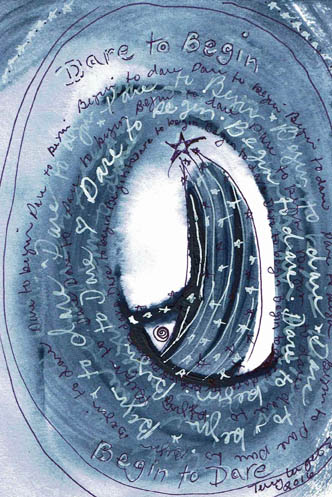
Here’s my Daily Art for the first day of 2016. Happy  New Year!

Today I started with the 5×7 Rives BFK printmaking paper. I worked with navy acrylic yesterday in different piece and I felt good about this color. It’s not been a favorite of mine in the past, even though it so represents the clear night sky. I wet the paper so that the acrylic would wash the paper and be less opaque. The fan helped to get it dried in time to meet my one hour time limit.

I have Sharpie Paint Pens™, both oil and water-based. The oil-based are transparent, the water-based are opaque. Usually I go for the water-based; they do a great job over acrylic paint and not all pens do. But I wanted to try the oil-based because it’s been a long time since I’d used them. As I thought, the paint went on looking somewhat opaque but it faded as it dried. I continued to write “Begin to Dare, Dare to Begin” over the navy and all that showed was the barest grey letter outlines. I then switched to the white water-based opaque pen and began adding viewable text.

If you are unfamiliar with asemic writing, it is writing that is without content. Asemic writing resembles mark-making; it compels one to look and look, trying to find words that can be made out, to construct a meaning. It’s handy for me to enjoy the look of asemic writing because my handwriting doesn’t enhance my artwork at the level I’d like it to, especially in this era of carefully and creatively hand lettered journal pages. When I do hand letter a piece, I’m not aiming for highly decorative or readable text; rather, I work to my weakness (strength?) of indecipherable messy lettering. But in contrast to asemic writing, rather than being without content, my content is simply unreadable. I have a Pinterest page where I collect asemic images, if you’d like to explore it.

I began to encircle the center image with white Sharpie™ water-based pen. At first the navy shape inside the white center looked like a long-haired female with an arm outstretched. But I also saw trails like a comet, so I went with that idea, which seemed more expressive. I didn’t want to write with black, so I found a Sharpie™ extra-fine pen in purple. I thought purple looked more like the cosmos. I wrote with it in a different size in order to create greater contrast to the white writing. At this point, the image looked as if it needed more gravity on the page, so I did imperfect circles around the center. The empty center and outer circles created a mandal; a Begin and Dare mandala. I signed and dated it which is another “rule” of the Daily Art Initiative.

The subject matter of “daring” relates to Lisa Sonora ‘s current 30 Day Journal Project that began today. The prompts today were about achievements and what had to be dared to accomplish them. My journaling was about commitment and beginnings, so I brought those ideas into this piece. It’s possible that this 30 day challenge will inform other Daily Art projects.


thedragonknightsteed

I already spent most of the day blogging at Mythos so I’m going to reprint a page from my process journal about this piece:

December 1 & 2:

Nikki (Nikki St. Laurent) made the Dragon’s Eye pendant and I had a torch fired hoop that worked color-wise. I tried various combinations and went down that path for quite a while. Finally I had an arrangement that used a spectacularly colored designer leather scrap I swore I could never find a use for. (Note: it looked like dragon scales). I LOVED the leather with the finish on the dragon eye, so reptilian and mythic. By Day 1 end I had a workable design that just needed minor assembly and a closure.

Day 2 I was still good with the piece and pleased with the component meld, but the closure stumped me. It was too heavy for a leather lace. Ball chain was out. I tried every silver chain I had and none worked so I thought of going to the store. The more I thought about going to the store for chain and a clasp, the more I thought about Make Do. I noticed a buckle part on my table…beautifully etched and in the shape of a shield. I removed the torched hoop and decided to form horsehair to create a loop on the bottom of the shield.  I really did not want to leave off that leather, but then I thought about the courage of the Knight. Courage, “la couer”, the heart. Also, the heart of the Steed and the red of scapulars. It occurred to me to make it a “badge of the Quest” scapular so I decided on deep red thread and seam binding to help form the horsehair. I knotted the hair at the bottom, sewed it in place, leaving ends to appear from behind the shield. I ran horsehair through the buckle hole, knotted it and ultimately hung the dragon’s eye off it at the top. I attached a tiny heart-shaped lock with a tiny brass safety pin.

The Knight is on the Quest, the Dragon guards the treasure the Knight seeks. The mythic story. But what of The Steed that carries the knight for many days over arduous land. Certainly he represents the energy needed to carry the Knight to the final destination. The loyalty and stamina. This is my tribute to the Steed.


barebear

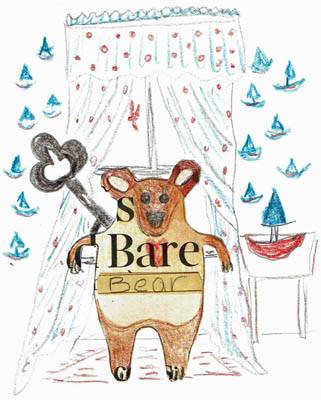
Here is my creation today. It is expressive art mixed media that began with this image:

b4croppedweb

How did this image come to be? About six months ago I bought some stencils at the Dollar Tree. There were five sets available: Sea Life, Farm Life, Alice in Wonderland, Monsters and an alphabet. (I wrote about these at Mythos in an entry Idea Farm). I bought the Alice set and opened it about a week later and it was awesome. Yes, the stencils are on lightweight cardboard, but they were detailed and cut cleanly. The images they selected were not all mainstream. On my next trip in I decided to pick up each set.

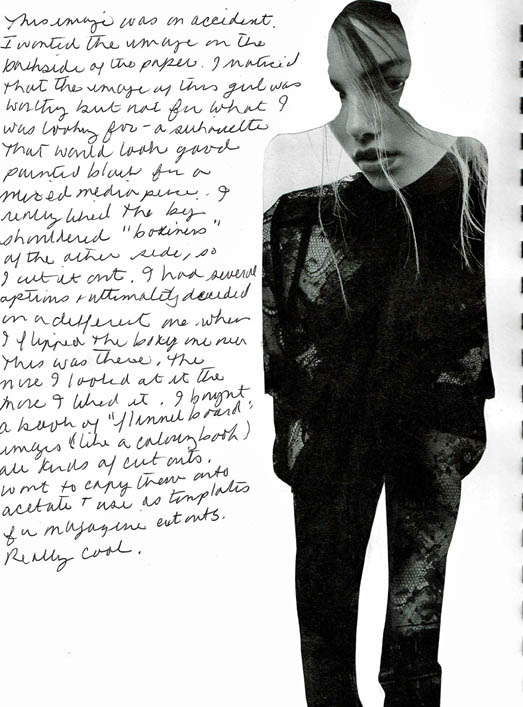
For some reason, perhaps all the children’s books I’ve been looking at, the Monster set got appealing. Actually, it started further back than that now that I’m thinking about it. About a month ago I decided to do a mixed media piece using a black silhouette. I’ve done these before (some of them are shown on this blog). Basically, I find an evocative fashion magazine image, one that will translate to being blacked out. I cut it out, paint it with black gesso and create a background to put it on. It’s fun to do and cool to look at. In this instance, I found a couple good samples. I flipped them to the back, and one of them had an image I had not planned. I decided on a different image for the piece I was working on, but I wanted to remember to try this, although as I say, it was an accident. I was going for the boxy pose on the other side. I put the image in my process journal and made notes about why/how it had happened. I left my notes on there but not sure you can make them out.

accidentalcutoutweb

I think this was backburnering, then the children’s book thing happened. The Dollar Tree stencil sets are a good size for my 5×7 Daily Art Initiative projects. During TV time, I go through books and magazine pages and hold the stencils over the pages to find ones that utilize the images on the page.

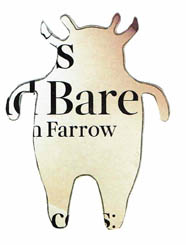
Because the Monsters (I prefer Creatures, because, really, they are more cute than scary) were abstract I started with that set. Oh, the fun that I had. I tried to use all the Creatures, but found I was partial to several. This one seemed “bearish” to me, it also reminded me of a shaman cave drawing. When I saw the word “Bare” printed on a page I couldn’t resist myself.

All the little guys and gals got gelled down to a full size piece of paper, smack dab in the middle. I’m not sure this was necessary but it seemed like it was, so that’s what I did. The idea was to scan them, crop them and then be able to stick them all on a page(s) to print out to conserve paper. Seems counter-intuitive, doesn’t it? I do not want to use the originals.

I have about 30 0r so done. See my last post about how fast my new Brother inkjet scans. I sat down the other day and scanned them all, then I sat down yesterday and cropped them all and grouped them in files so I could do what I did today, quickly and efficiently. It was a lot of work to digitally resize them and organize them, but if I don’t do it right away, they will just get lost and not get used. Another important Initiative in 2016 is to develop the habit of Organization, but I digress.

I wanted to use Bear, so I picked this one because of the Bare fun factor. I am easily amused. As you can plainly see, the image RESEMBLES a bear, if you squint and tie your Imagination Hat firmly onto your Noggin. Colored pencils are a dry medium so I used my Prismacolor set. I adjusted his ears and they were way too big, which sure set the tone right off the bat. Then I drew the face. I swear to God, the first face made him look like a rat. I couldn’t even with it, so I erased and started again, making the face bigger and wider, and that got better. I messed about giving him paws and shading him in. But there was that awful “Farrow” word that had to go. What to do? I thought the best thing would be to cover it up with a dry, opaque something and decided on ledger paper. I wanted to write the word “Bear” out because I thought maybe the drawing wasn’t good enough to allow you to get the joke. And the paper was all lined like elementary school, so I wrote “Bear” in a childish sort of way.

About now, I have an ugly bear with a childish look and goofy word and a pretty elementary pun to boot. Then I read it. “Bare Bear.” It sounds like what a kid would name a favorite, cherished stuffed bear. This is no longer a bear, its a bear TOY. But it was standing up so tall, not like a stuffed bear. Then I thought, it’s a wind-up toy bear that walks. But how to show the winder thingy? They are called keys, and this is an old school toy, so I can just draw a key winder. I made it big to make sure you could see it and know it was a toy bear.

Man, I only had an hour and I was running out of time. That rat face put me way behind. This toy bear made no sense at all standing in the middle of space, he needed a room. A kid’s room. A boy kid’s room. So I drew some curtains and put on some sailboat wall paper and an out- of-perspective table with a sailboat set on it. I polka-dotted the curtains and was just putting the red fringed rug under Bare Bear when the timer went off.

Ok, we all know this is no Beatrix Potter but I don’t give no fiddely dee about that. I like this; I like everything about this. I especially like these things: I enjoy doing this during TV time because I don’t enjoy TV much; this is super cheap–.10 magazine, $1 for 20 or so stencil images; the process spurs on imagination; drawing practice. Mostly I like this cute little bear waiting for a little boy to wind him up and give him some animation. Good ‘ole Bare Bear, long may he bust a move.

dailywolfracesredweb

My Daily Art Initiative is detailed here. This post is to discuss the process of making the above pictured piece.

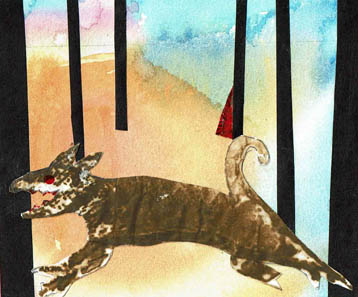
This image was made in one hour on a 5×7 sheet of damp Rives BFK printmaking paper. The background is Pelikan’s gouache paint. I used colors intuitively and when I was finished painting I held a small fan close to the paper to dry it. (Obviously the fan is completely enclosed in a heavy wire cage for safety).  It took longer to dry than I thought it would. Remember, I’m on a one hour clock.

If you’ve read previous posts you know I have been experimenting with walnut ink and ink crystals. I use a waxed paper sheet (like deli paper only more see through) underneath any inking projects; walnut ink stains everything. I keep the paper because, well, you know. Because it’s paper and it has walnut ink on it.

A cat, let’s say, Peter Pan, knocked one such walnut ink paper off my desktop. I can’t swear in a court of law that it was Peter Pan, but I have a strong feeling it was. In this case, and likely ONLY in this case, I should thank him for it, because as I was bending to pick the paper off the floor (in order to prevent a vaudeville-like slip resulting in a worker’s comp case AGAINST MYSELF) I distinctly saw a running wolf with it’s mouth open showing his teeth. It was the head and mouth that was the easiest for me to see…although the tail and back leg were also prominent. It was just the proper size for a 5×7. I copied it on my Brother All-In-One inkjet printer. I am going to pause here to discuss this printer.

After some discussion and research Bob and I decided to get the Brother Work Smart series model MFC-J885DW inkjet printer not too long ago. I have not had an inkjet printer for quite some time. Previously I had a Canon inkjet which printed very nicely when it would print. Which considering the print head failed after 10 hours of printing wasn’t very often. I was given the first one, and it printed nicely and so when the print head failed I figured it might have been used a lot before I was given it. Just a note: if your print head fails, it costs 2x as much to replace it as it does to get a new printer. So I bought a new Canon, and that print head failed as well, unfortunately after it couldn’t be returned. I gave up on inkjets after that. We all know why, but for the five of you out there that might not, I’ll go ahead and say why. It’s because that you can purchase an inkjet printer for $19.95 and it will print very nicely, and the print head might last longer than 10 hours, in which case you are grateful. But then the fun begins. Long about 10 copies in, the dinky starter cartridges of ink that came with the printer are all drained, then you have to replace them with full size cartridges, sometimes each color separately, but at LEAST two cartridges, one black and another tri-colored. Actually, it is better if the three colors ARE separate because at least then one doesn’t have to replace a tri-colored cartridge just because you got all into yellow for awhile and now there is no yellow left, just the other two colors that have to be tossed like the proverbial baby with the bathwater. Whether you have the tri-color refill or the individual refills hardly matters, because all of them are going to require a second mortgage to replace. You see, it’s the bait and switch deal. They pull you in with a cheap printer that’s head will fail right after the time you buy the refill inks.

So, we’ve struggled along with our most excellent laser all-in-one. Laser printing is most economical but, alas, just black and white copies. Actually, it is most economical but the toner cartridge, which will last well into the next Presidency, costs $80. Sigh.

It started to seem as if I wanted color copies. I considered scanning and sending to an office supply store; color copies have gotten less expensive than they used to be ($1). However, to do this I would have to scan each item. Meaning, if I had an inkjet all-in-one I could just photocopy which is more efficient. The Brother had great reviews and the ink tests and prices were decent. And it was a great decision because I seriously love this machine, for a bunch of reasons that I didn’t even anticipate. It is fast copying and printing. All good. It is wireless and it works. Very nice. It has a touchscreen that runs it. Wow. I don’t even need a computer on to use it. It saves right to a stick drive. I control everything it does on that touchscreen. And the scanning, oh the scanning. Perhaps it doesn’t have truly professional scanning options but who the hell cares? I can scan in about 15 seconds, with no computer. I. Can. Scan. In. 15. Seconds. And, because it’s Bluetooth wireless, I can go in the other room, use that computer, use Adobe and send it to the Brother.

In short, I am in Brother All-In-One Worksmart heaven. This could be the single, most revolutionary thing to hit my studio in a long time (besides me being in there). I am not kidding.

So back to the art. Blots on paper are odd. When you use the copy machine, sometimes the blots look different than IRL. Maybe it’s the difference in the paper texture, I don’t really know. I copied the blot but it didn’t clear up the image, it was almost the same. I did use the inkjet copy to trace the image of the wolf as I saw it and decided to use that tracing as my cut out. Remember, I’m on a one hour clock. If I wasn’t on the clock I might have taken the time to redraw on the original blot, but I didn’t have the time.

The wolf needed a context. With Little Red Riding Hood uppermost in my mind these days, he was placed in the woods. Just black paper strip trees. I found a tiny piece of red paper and I colored over it with a red Copic marker. I tried for some perspective by varying the depth of field of the trees. I finished with one minute to spare.

This piece could use more detail work. I might put some grass and stones under the wolf to get him further into the foreground. I would have to do something with where Red is. The watercolor background is not very suited to the woods, it is way too bright. Red actually looks like she’s standing on the edge of an orange cliff, not picking flowers for Grandma. One more step to the right and the least of Red’s  problems is that wolf. Yes, in it’s current state, all told, it is woefully inadequate. But it does have that urgency, not withstanding it’s flaws. And it got made, all by me, in one hour.

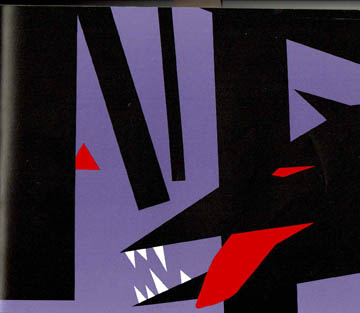
Ok, how did I get this image. Besides the inkjet and paper, I mean. A big part of the how is obviously the obsession and research into LRRH. Pursuing a search of LRRH in my local library’s catalog, I found a book called Picture This, Perception and Composition, by Molly Bang. I had no real grasp of what this book was about, but I requested it. Turns out, Ms. Bang had done some research of her own, into shapes and colors. I am talking extremely abstract shapes. Normally this wouldn’t interest me much, except that she used LRRH as an example of how to build a narrative illustration using ONLY simple shapes and minimal color.

Step by step, shape by shape and piece by piece she takes us through building an image. If the triangle leans in, it feels this way. If it’s smaller, it feels this way. What will make the wolf scarier? How can we put Red into more danger? She ends up using white teeth, mauve background, black trees and wolf shape. Red triangle for Red and red in the wolf’s eyes and a big lolling red tongue. OMG people. In a million years I would not have put this together, EVEN THOUGH, I’ve studied color and universal shape meanings for 30+ years. This is a book that demands re-visiting, re-reading and direct application over a period of time and many experiments.
BangLRRH

This photo copyright 1991 by Molly Bang, from the book “Picture This, Perception and Composition.

It is obvious that this author knows her subject. She has personal knowledge and has used the technique with students of all ages. The book is simple because she made it that way. The concepts are complex, her presentation is digestible. Look at what I did, after just exposure to her concepts. I simply do not believe I could have rendered this work before. I urge you to give yourself the gift of this book if you are interested in the emotional, psychological and perceptional aspects of shapes and colors.

Astonishingly, this book is available used on Amazon for .01 plus shipping. You know where I’m going.

Afterword: I receive no compensation from Brother, nor am I an affiliate for Amazon. Molly Bang is a prolific illustrator of children’s books. The illustration from the book Picture This is used as an example for education and review only.

fabric paper copies

When last we met, Fabric Paper Part 1, I promised a follow up about my uses for the paper. Well, my purpose in making the paper was to cut it up and make bracelet cuffs from it. I still intend to do that, but I  haven’t gotten to it yet. So this post is about art journaling.

I don’t usually decorate the cover of a journal first. To be honest, I  rarely get past the first three pages of a journal so nearly no covers get done. It’s not unusual for journal makers to leave the cover for last. Perhaps the idea is that after the journal is completed there is more of a tone to bring to the cover than might have been apparent at first. Perhaps the idea is that the cover might get so monumentally messed up that nothing could fix it and it would be forever lost. Not a very good way to start a journal. My feeling is, I need to love that book to the point that I can’t leave it alone.

I don’t usually follow the market for supplies. I’ve used various mixed media sketchbooks, hardbound and spiral bound. For some reason, spiral bound journals started to bug me. I actually used to LIKE spiral bindings, so I have no idea what that is about. And, the hardbound journals I had would not stay open or lie flat. That started to bother me, too. Wet pages had a mind of their own and would flip closed to the other side. (Don’t write to me about clips). Anyhow, I saw a few videos by Ranger for the Dylusions Creative Journal. It is a bound journal that opens and stays perfectly flat on it’s own with No Clip. The paper is heavyweight and suitable for wet applications; the cover is heavy chipboard. The 8.5×11 journal retails for $25 at Michaels, so I wait for a 50% off coupon and buy it; at $12.50 this 64 page journal is an excellent buy.

If you’ve been keeping up with my Mythos blog, you know I’ve developed an obsession with Little Red Riding Hood. Since I posted over there about Red last week, I’ve gotten an obsession with all the Grimm Bros. tales, and the Grimm Bros. themselves. I plan next week to get an obsession with Hans Christian Anderson, to be followed by Charles Perrault. Ultimately Mother Goose will be involved, at which time if I’m decorating my bedroom as a nursery I expect professionals will be called in.

So, I procured me a new journal: hope springs eternal. And I decided to tackle the cover first. Mother of Pearl, what a confunction.  I have no hand-lettering skills. (Could this be at the base of why I am a journal writer that does not write journals?) How was I going to get the text on? Was I going to collage a cover? (Treacherous). Was I going to draw a cover? (Unlikely). Was I going to paint a cover? (Unlikeli-er). Maybe I wasn’t thinking out of the box enough, but it seemed that about covered it, technique-wise.

Finally, I considered stencils. It’s hard to imagine that I didn’t think of stencils right away, because there is a good portion of my grey matter dedicated to thinking about stencils. I have several tree stencils of the right size.  Then the decision: paint or ink?

Acrylic paint has drawbacks; it creates a slick “dimensional” coat. I felt it could limit my options later, both for material and technique. Ink also has drawbacks, the first being, I don’t like the look of sprayed ink. It CAN be very inconsistent and temperamental. Like, I spritz it off-project a couple times and everything is good, then I move onto the money shot and it fires out blobby and drippy and with extreme prejudice. One time it actually blew the stencil off!

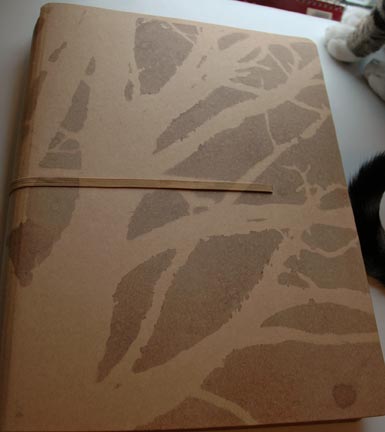
I didn’t want the cover black, and I didn’t want it colored, either. I wanted it natural, so my mind went to walnut ink crystals. I had some ink made up already. I also had one of those Mini Mister applicators. I thought the smaller mister might give a more consistent spray.

I had to take it outside because walnut ink stains just about everything. Particularly cats, and they seem to jump on my work island just as I am executing a critical treatment. My experience with spraying any ink is that it goes all over the place, even though you think it couldn’t possibly. (A good idea for you is to put the ink-ee into a box; that is, if you, as a well-prepared artist, can put your hands on a box that doesn’t have black widow spiders inside it. I am not so lucky. I am not making that up.)

Outside I went. I had applied TAPE to keep the stencil laying down. I tell you, I was firing on all cylinders. I got the mister going and I was right, the Mini-Mister did a good job with a fine spray, consistent and very much enhancing the detailed stencil. However, mysteriously I did produce two large drips. The biggest one ended up spreading out and isn’t too noticeable. The smaller one is at the bottom. While I was out there I sprayed the edges of the journal all the way around. The edges always get messed up on my journals anyway, so I figured I’d grunge them up from the beginning. woodsjournalstenciled

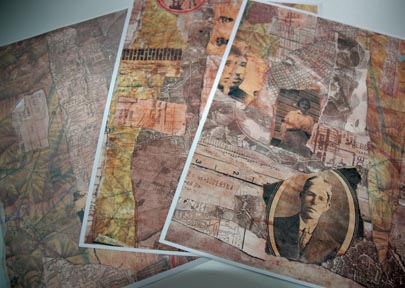
I left off working on it last night to let it dry properly.Today I was faced with Now What? There were many options. I considered collage for the tree trunk and limbs with small pieces of paper. That’s why I copied the fabric paper–some of the designs worked for tree bark and texture. I tore a couple pieces up and tried it and I didn’t like it. Not One Bit. I tried a teeny dictionary with tiny type to collage the trees. That was better, but with the busy all-over stencil design I was concerned the collage would be overwhelming and make the tree look stiff and clunky.

I decided to take a break so I sat down and outlined the tree with a fine line black marker (Artline) and that created considerable depth to the image. At this point I considered doing very very very small handwritten text along the tree trunk and limbs. I was very tempted to do it, being that it is one of my favorite activities, but it might be even busier than the collage. No go.

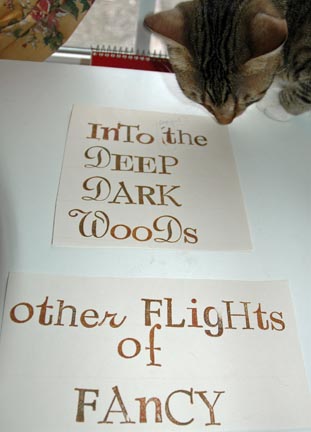
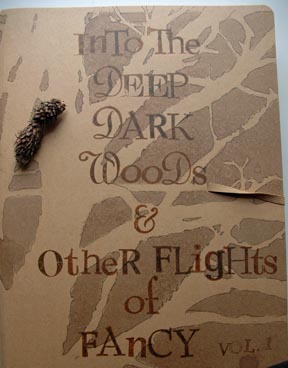
It’s not possible for me to hand-letter the journal title. I considered transferring toner or inkjet computer text to the cover. (Treacherous). I thought maybe I’d do a packing tape or Contact Paper transfer. (Easier, but the stickers can look clunky). I did not want to stencil again, even I know when to stop. So I went into the stamp hoard and found this alphabet (I cannot tell you who made it, the packaging is long gone). It was amazing that I bought both the capital and lowercase set of this font. I must have realized 15 years ago that This Day Would Come-And It Did.

woodsjournallettering

Isn’t it nice? You can see that I had to do a pre-stamp trial run…better safe than sorry. I have been sorry SO many times. I loved the font and the color (StazOn Saddle Brown). I took the plunge….wait for it…

woodsjournalcover

This is where I stopped. You will notice that I optimistically added the “Vol. 1” notation as an afterthought. I’m pulling out the stops to get this journal on a good trajectory. I Winter Solstice-ed it up for you by adding a cheery pine cone. I know how you appreciate that Martha touch. (I reread this post and see I’ve mentioned two Ranger products. I do not receive any compensation from them and actually use very few of their products).

The cat is Peter Pan. During the above process, I listened to Dr. Clarissa Pinkola-Estes, “The Theater of the Imagination”. Today it was Bluebeard. Her telling and analysis is a must hear for women.

fabric paper step 1

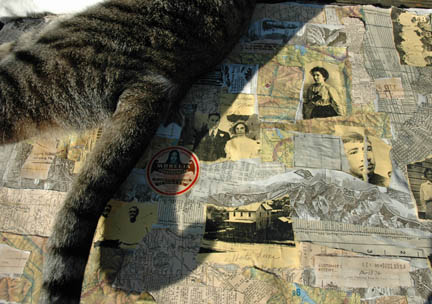
I will apologize first off for the blown out image. I hate shooting in the sun but today there was no alternative. Also, the cat would not move and he weighs about 45#.

Fabric paper offers a lot of opportunities, and I have exploited them often and with great enjoyment. Any fabric will work and I have variously used vintage linen and new fabric. Keep in mind you can cover the fabric up as much as you want with the paper. If you use a print or solid that you want to show, leave gaps between and/or around the images.

After you decide on your fabric the next step is to decide on your images. I find that working with too-thick images doesn’t work, i.e. postcards. They are too thick and too inflexible, but go ahead and experiment if you want to use them. They would be cool but I find the thickness frustrating.

Let’s also say this now: My intention at this stage is not to make a masterpiece. This is the foundation of my ultimate use for the fabric. My mode is to look for texture now, or interest in a background sort of way. Later it will be embellished with whatever you decide, thread, more detailed images, sewing, beads.

I use Mod Podge™. I’ve said this before on this blog. It is an inexpensive alternative medium, thick, with good body when dry and it does the job. I pour the Podge™ out on the fabric, squeegee it around with a credit card and quickly apply the papers. It’s a good idea not to work with too much real estate at one time. Podge™ dries fast, but don’t worry, put on more if  you need to.

Concentrate primarily on getting the papers stuck in place. There isn’t a need to go over them with Podge™, but if you get some on top, just swipe it with the credit card. The reason you don’t want a bunch of Podge™ on the top is because it will make your Fabric Paper more sealed and plastic-y. If you want it this way, go for it. But any ink, paint or dye you want to put on later is not going to get absorbed well. Actually thinking now about it, if you want a streak or texture you can exploit the “resist” aspect by deliberately creating marks with Podge™ that the liquid color won’t cover. That would be fun.

Get all your paper glued down. If there are ends or edges that aren’t glued well, get some Podge™ on there and smooth them down, especially if you are not going to sew at all. Sewing helps get everything put down that you might leave unglued. I like to have some edges not stuck but this could bother you. If you are going to sew on top and you aren’t sure, do some looser to see later how it works for you. Remember, it’s just fabric and stuff you’ve got around the place giving you allergies.

There will be wrinkle-age. Deal with it! Some of them will flatten as they dry but some of them won’t. That’s the way the cornbread crumbles.

The humidity, thickness of fabric, amount of Podge™ you used and the phase of the moon will determine how long it will take to dry. It has to dry through all the layers, so don’t push it. Better safe than sorry. You do NOT want to run damp Podge™ fabric through your sewing machine. I can’t EVEN tell you what that mess would be. Learn patience.

After your fabric is dry, decide if you want a unifier besides sewing. By unifier, I mean a layer of paint, ink or dye. I am currently experimenting with walnut ink that I make from crystals. I love this stuff (you can find it and other wonderful things at animadesigns) and get a real kick out of throwing everything in there to see if it will work. (See another example here). More about those experiments at a later time. For now, I made a strong brew, about 1/2 tsp in a salsa container. I ate the salsa first. I used a large paintbrush to apply the ink. It beads up on any spot that has heavy Podge™. It will also puddle in low spots and I like this. I try to get a coat on every part and especially between the images and around the edges of the fabric. After Coat 1 is dry, apply Coat 2, really getting into any areas you want darker. I want it unified, but not all the same tone.

Now, if you use acrylic paint instead as your unifer, work in a small area, paint over top of the images and wipe down quickly. Use the same heavy/light application technique, but layer and go slow. It’s easier to add more, impossible to get rid of unless you sand and there goes your paper. With acrylic paint you can also add an acrylic medium to make more of a glaze and longer working time, that’s more like inking. Remember, acrylic is plastic. It’s a permanent coat.Fabric Paper step 2

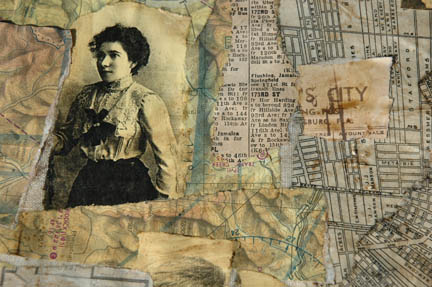
Walnut ink is a subtle dye. Also, it is a purplish brown dye, keep that in mind. It looks murky in the container and when it goes on, but it dries light. I trust you can see in this picture how the papers seem more one tone, how the muslin is toned, and a few paper edges are really dark.

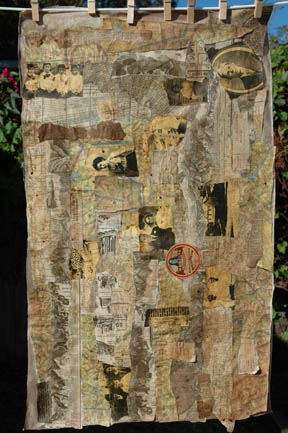
I decided that I wanted two coats for now. It got hung on the washing line to dry. In the Florida sun it was probably dry by the time I got the last clothespin on, but I wanted to write this up so it’s still out there.

It’s coming along nicely. In Part 2 I’ll tell you what I’m using it for and we’ll see what I decide to do before I sew it on the machine. I know you are busting with anticipation. Get a grip on yourself!

Fabric Paper Washing Line

Great things happen when listening to Jane Siberry’s “When I Was a Boy”.