 I fell in love with a scrapbook set of papers with a Japanese theme a couple of weeks ago. It had the usual back up accessories, like chipboard pop outs, stickers and alphabets. The little geisha and the bird were two of my favorite images from the set so I put them together. I was out in the garage and found this very stuffed but flat backed geisha doll and wondered if it is possible to go THAT 3-D in an art journal. Well, it is but with some caveats. First of all, your paper needs to be up to the task of holding the piece in place. This is my new go to Montval watercolor paper journal (90#) from Canson (the All Media I’ve already spoken of several times). The paper is pretty heavy, so that wasn’t a problem. Also, I set the found object geisha toward the spine, which would be my second suggestion: placement on the page. Third issue is that I forgot that this wasn’t a “stand alone” project like so many of mine are…soooooo, it is a tad tough to journal on the preceding half dozen pages. They are all lumpy. Because the top of the geisha is all stuffed and junk. So keep that in mind. One thing that would be SMART, so it never occurred to ME, would be to plan to have the stuffed geisha on the page but not actually PUT it on the page until you got any page effected by it finished, like the previously discussed preceding half dozen pages. Duh. Anyway, learn from my mistakes, grasshoppah. Don’t let the 3-Dness of an item immediately negate the idea of it in your art journal, but take my advice and do a little planning first. Think how it’s going to effect the rest of your work nearby. By the way, at the National Scrapbookers Day event I demo’d at this past Saturday, this page was popular. It definitely offers the unexpected as you flip through the book. p.s. Bamboo was stenciled with Dylusions ink. Awesome.
Geisha doll 3-D art journal page
Posted: May 9, 2012 in art journalTags: 3-D, art journaling, mixed media, new art work, scrapbook paper, stencils
Calendar pages art journal
Posted: May 8, 2012 in art journalTags: art journaling, calendar pages, journaling, mixed media, new art work, spray ink, stencils
 A simple grid over a two page spread became the foundation for these calendar journal pages. The upper left box contains a Crafter’s Workshop stencil image sprayed with Dylusions spray ink. I love dandelions and couldn’t wait to use this stencil. I hope you can at least see some of the watercolor effect the Dylusions spray ink had, and I love the intermixability of these inks. As you can see not each square of the grid has journaling. I used scrapbook paper scraps and turned the dandelion stencil wet side down after spraying the main image to get color on the right bottom center and right near bottom square. I do not like wasting ink!! Because the stencils are plastic the overspray stays wet a long time and it can be monoprinted onto any other page or project you have going. I put an opened up cardboard slide holder on the bottom right square and stamped “April” on the bottom right with what I believe is a 7 Gypsies journal rubber stamp set. I liked prepping and using this spread so much that it is now the second class in my Art Journal series beginning in a couple of weeks at Whim So Doodle in St. Pete. Prepping is easy. Draw the grid, watercolor into each square by mixing your colors and making each square a different color, spray some with ink, use a stencil that you like that goes along with the month you are working on. Or draw or doodle into squares to make it even more personal. Pick a square to stamp your month into, use a box style to write the date in each square that will be for journal writing. Put something cool in the remaining squares for visual interest. Then every day all you have to do is show up with a pen and write a few sentences into the appropriate square. Easy peasey.
Color study art journal page
Posted: May 7, 2012 in color studyTags: art journaling, color palettes, color study
 One thing that I love to do in my journal (as much so I can find them later as any reason) is color study work. I try to find some really unusual, prolific color choices in a piece of art or in ephemera, in this case some artists’ gift wrap from the turn of the century. I believe this was included in a collection of papers that I bought from Borders quite some time ago; they are unusual in the extreme, some of them so “busy” as to be hideously attractive which can move very quickly to plain hideous if the artist isn’t careful. This paper was the first one to catch my eye one day when I had the urge to do a color study. Here’s the way I go about it. I will take a medium, in this example the top color blocks are Neocolor II Caran d’Ache watercolor crayons which I super love and have a large set of. So I go thru the stash and pull out the closest matches to the colors used in the papers. I write the name of the color above the swatch. Underneath the boxes of color you will see some brush strokes where I did a more translucent sample. The blocks at the bottom are Prismacolor colored pencils. You might like to know the purpose of why I do these studies. First of all, I just like doing them, they are fun and spur me to get the supplies out and reacquaint myself to them. Secondly, they illustrate what a wild color scheme is actually made up of…perhaps when you look closely to do the study you see 2-3 colors there that weren’t obvious before. Thirdly, when you lay the colors out to the side in boxes, they look really cool and nothing like the wild pattern you’re trying to study and fourthly, now I have a color palette that I never would have come up with on my own, that I can translate into my own painting or bead work. Plus, it is a palette that is quite original and not the fad or fashion, but it’s played itself out in front of you so you know that it (or a combination of some parts of it) are going to work for you. So the whole reason I show you this is for you to shake the dust off your materials and find a piece of paper or fabric or artwork that is a riot of color and sit down to match up and document that article. Maybe you can come up with another 4 reasons to do it that I haven’t thought of yet. If so, please LMK.
Altered tote bag with original photography
Posted: May 3, 2012 in New Mixed Media art, photographyTags: ARTpool Gallery, mannaquins, mixed media, photography
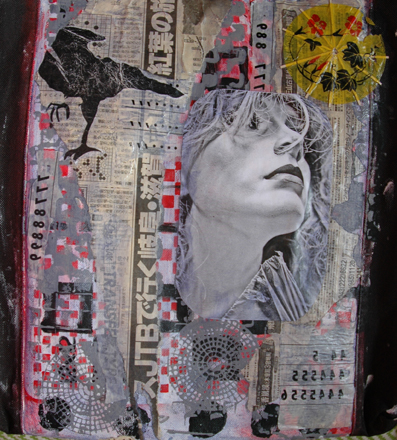 I picked up about half a dozen black edged canvas totes at a thrift store a while back and decided to alter them with photography and mixed media. The mannaquin photo is an original, altered a bit in Elements. That is a flattened drink umbrella in the upper right corner and a sassy crow image from Kerry Carbary in the upper left. The rest is tissue paper, asian newspaper, stenciling and rub-0n letters. The other side is collaged in a similar manner. This bag is about 4 years old but I notice my style hasn’t changed all that much. These materials remain favorites, as does my love of mannaquins as photo fodder. This tote and several other altered purses will be featured in the Trashion Fashion show at ARTpool Gallery in July. The first time any of my wearables have been in a show. Yippee!
Stitched paper quilt with cut heart overlay
Posted: April 30, 2012 in New Mixed Media artTags: mixed media, new art work, stitching
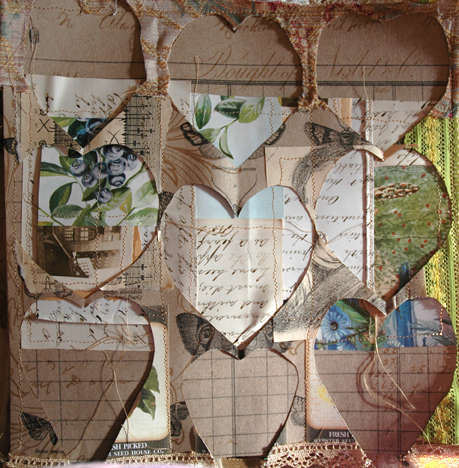 It’s a bit hard to tell in this photo what we’re looking at. The foundation is a piece of scrapbook paper designed by Tim Holtz. On top of that is a quilted collage that is stitched together, made entirely of paper items, which in turn has been stitched down to the foundation. The top layer is one of my stitched collages made from both fabric and paper that did not suit me after it was done, so I cut it up into heart shapes to use on future stitched collages. The “waste” as it might be called, was then stitched overtop the two previous pieces. This is one of those items that loses a little in photographic translation…it is easier to see what you are looking at IRL and to discern what it is.
Graffiti wall, crop three
Posted: April 28, 2012 in graffiti, photographyTags: cropping images, graffiti, painting, photography, rule of thirds
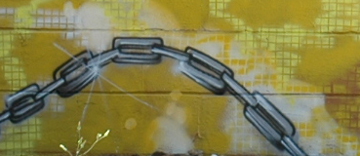 This is not a great crop. While the chain is interesting and most of the focal points are in the rule of thirds, there is an annoying plant from the foreground surging up on the left, and the dribs from something that should have been entirely cropped out on the edge of the middle bottom. The chain is beautifully done but there isn’t enough variety to hold the interest of the viewer. In this case, a little too much repetition, so much so that we find the distracting plant and darker element almost a relief. The artist is not to blame for the lack of interest. This item was at the very bottom of the wall, it was never meant to be a focal point, but rather (in my opinion) a filler. Yes, a very well executed filler, but a filler. I do love seeing the patterning on the wall behind the chain, but again, this is background in a very small area, not meant to have our undivided attention. My point is this. Just because I am in love with something, like the look of this sprayed chain, does not mean it can carry a crop. There must still be an adherence to rules of good composition, plus a little more to look at.
Graffiti wall, crop two
Posted: April 27, 2012 in graffiti, New Mixed Media art, photographyTags: cropping images, graffiti, photography, rule of thirds
 Another crop of the magnificent graffiti wall shown earlier in the week. This crop follows the rule of thirds, with the lightest toned part of the image (mountain) on a third. We have an off centered crop and the repetition of the shape of triangles three times in the focal points. When selecting elements to crop, a good rule of thumb is to use an odd numbered amount of focals. We have lost and found. Keep in mind that the eye goes to the lightest color first when viewing an image, so the lightest should be well placed. There is a hierarchy of what the mind wants to see and how it orders it. Light color, face parts (human) face parts (animal) face parts (babies). Of the facial expressions, eyes then mouth. Hands and feet are important. Light colors moving to dark, other body parts. So if you want to crop a face, always try for the eyes first placed on a third, using the mouth on a third or eliminating the mouth for a stronger crop. That way the mind doesn’t have to play the choice game of what to look at. As I view this crop I notice a lack of emotional response. I was more interested in yesterday’s reptile tail. I believe that is because of the curvilinear look of the tail as opposed to the very linear shapes of these buildings. Also, these buildings are man made, the tail is natural and belonging, we assume, to something live even tho we couldn’t see the entire animal. We can appreciate the skill needed to create these buildings ON a building, the texture mixes, the shading for the windows and door, etc. But the image does not stir me like yesterday’s crop. Perhaps it is my skill in cropping, perhaps this crop is not as good as yesterday’s. But if it wasn’t for the mountain (nature) in the background, if that had been another man made building and not a mountain, you probably wouldn’t be looking at this image today. The mountain saves this crop from being a study in architecture.
Graffiti wall, crop one
Posted: April 26, 2012 in graffiti, photographyTags: crop, cropping images, graffiti, painting, photography, rule of thirds
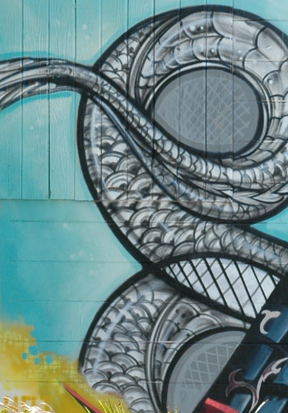 From yesterday’s full document style picture of graffiti in St. Pete, we have today’s first crop of crops. When I was looking at the full pix yesterday the most intriguing part for me, being a reptile lover, was the tail billowing from the back of the Viking warrior. The artist rendered the scales most beautifully, and I love the shape, which reminds me of an upended infinity symbol. I wanted most of the tail to show, but not all of it, so I sacrificed the very end. This creates the desirable effect of “lost and found”, which is also in play on the right side of the crop. It is more intriguing for the image to “wander off” the page, and return, than to see the whole thing, perhaps smaller, in the shot. Of course, this could have been even further cropped by showing only the one top curled part of the tail…there are always several good options when an image is well composed to begin with. But I liked the blue against the grey-the yellow against the blue-and the part of what might be a shield in the very bottom right, with it’s runic suggestion. Please notice that the middle of my crop is nearly empty of interest. What is there is merely moving the eye to something more interesting. All the action is in the thirds and in the very bottom corners. While the viewer has no real idea of the magnitude of the original “document”, the crop is satisfying on it’s own and that is what I think makes a successful vignette. It creates the desire to see more, but not an empty desire.
Graffiti wall, composing, cropping
Posted: April 25, 2012 in graffiti, photographyTags: composition, cropping images, graffiti, painting, rule of thirds
 Elizabeth from the excellent Glowing Wheel blog sent me a thoughtful comment yesterday after my post on cropping artwork. I appreciated the comment because it reminded me of how difficult it can be to get the original photo composed well, whether it is a found shot as above or a shot (scan) of our own artwork. Or composing the artwork to begin with is often a challenge. So I thought, on my 101th post, I would discuss the rule of thirds.
The rule of thirds is this: Imagine two equidistant lines vertically and horizontally over top of your image. Where these lines intersect is the most advantageous point for your main focus. There can be more than one focal point in a composition but one should be dominant and there should not be too many! For more insight than I have space for, check out “rule of thirds” on Wikipedia for a good explanation plus examples. The rule of thirds applies to photographs, collages, paintings and mixed media pieces as composition is always rule one. It doesn’t matter how fascinating or beautifully rendered the subject matter is, bad composition will not convey it.
The photo above documents what I saw on a wall in St. Pete approximately two years ago (sadly no longer there). The artist composed well and your eyes move successfully around the image in a satisfying way. One feels one has seen the entire composition in one look. This is good. As one who likes to crop, however, I see many intriguing areas, both inside and outside the “thirds” that I would like a closer look at. As the week progresses, I will do some cropping that satisfies my curiosity, and perhaps yours as well. I will try to explain how and why I cropped as I did. And you will get a closer look at this excellent artwork.
Cropping your art
Posted: April 24, 2012 in photographyTags: found images, graffiti, journaling, mixed media, painted canvas
 Close cropping is nothing new to photographers but I think as artists we sometimes forget that in every composition it is possible to find small, interesting bits that can stand on their own. Particularly when it comes to what the human mind finds intriguing, such as faces of humans and animals, body parts of same, etc. Also in our images it is possible to find small arrangements of odd numbered items or marks that make a substantial impact on their own if cropped. I find that cropping “busy” subjects, such as the graffiti I’ve featured on this blog frequently, lets the mind appreciate what is there in smaller mind-sized “bites”. While a wide angle shot (or full shot) documents a piece, a close crop provides more of a study.
 Crickyn